


How to Remove Hard Water Stains from Glass, Faucets, and Shower Doors
Hard water marks are one of those household issues that can turn an otherwise immaculate bathroom into a neglected space. Cloudy shower doors, white areas around taps, and persistent mineral rings on glass items are among the frequent problems in many Tampa residences. The frustrating thing is that regular cleaning does not always get rid of these stains. These marks may not always be mere dirt; they are mineral deposits left behind as water evaporates. If you want to keep your bathroom looking fresh, professional house cleaning company Tampa can help you maintain the surfaces that are most likely to be affected by mineral deposits on your premises.
What Hard Water Leaves Behind
Hard water has minerals such as magnesium and calcium found in nature. While water passes through the ground and rocks, these minerals reach your plumbing system. Although they are not visible when in the water, the stains become visible after water has evaporated.
When droplets evaporate from faucets, glass doors, mirrors, and tiles, the minerals are left behind. At first glance, you may see small dots. However, over a certain time, the buildup might become noticeable.
Thus, this is why hard water stains appear in certain places such as shower doors, faucet handles, drains, and edges of glass partitions.
Request an Estimate Today
Make your home spotlessly clean with Wow Now Cleaning
How Mineral Deposits Develop
The cycle takes place multiple times within a given day:
- Water meets a surface within a bathroom.
- The water evaporates.
- The calcium and magnesium stay anchored to that surface.
- The cycle continues, creating mineral build-ups.
Another reason why hard water stains and soap scum are often mistaken for one another is the fact that they appear on the same shower doors. Soap scum is formed as a result of soap reacting with minerals contained in hard water.
Most bathrooms, in fact, have both residues at the same time, which means neither of the cleaning products will be effective.
Common Signs of Hard Water Buildup
Be on the lookout for these signs while inspecting your bathroom:
- Chalky or white spots on your shower doors.
- Foggy glass that does not clear up even after normal cleaning.
- White circles around the fixtures.
- Mineral buildup around showerheads and water outlets.
- Various sedimentation on bathtub and sink edges.
- White deposits around bathroom tiles.
In terms of hygiene, a surface can appear clean and still become dirty because of mineral deposits. This is especially evident on smooth surfaces such as glass and chrome, where even a little residue can affect the overall appearance.
Why Vinegar Works on Some Stains and Fails on Others
One of the popular choices to deal with hard water stains at home is white vinegar. It contains acetic acid, which can react with certain mineral buildups, like calcium carbonate.
However, there’s a difference between removing several new water stains and removing years of buildup from a shower cabin.
When people look for white vinegar hard water stains, they want to find a cheap way to clean up their bathroom instead of having to buy special tools.
How White Vinegar Helps Remove Hard Water Stains
The acidic nature of white vinegar is useful in dissolving deposits that are based on calcium. Once the mineral deposits soften, they can be removed with gentle wiping and rinsing.
In the case of light deposits on appropriate uncoated glass, the vinegar solution can be used. Always follow the care instructions provided by the manufacturer and test a small area before proceeding.
Why Vinegar Does Not Always Work
There are many explanations for why vinegar cannot completely eliminate hard water stains from the surface.
To begin with, deposits can be too large. A strong mineral buildup developed over several months or even years can be hard to decompose by using weak household solutions.
Secondly, stains may include not only minerals. Soap scum, body oils, and cleaning products may create layers requiring their own cleaning method.
The third thing is that the surface can already be damaged. Some shower doors develop marked etching because of a long-term mineral accumulation. In this case, cloudiness is not a residue laying on the glass anymore.
Lastly, vinegar is unsuitable for every material. Natural stone as marble, limestone, and travertine can be damaged due to vinegar. Some metal coatings and finishes may also be damaged.
We strongly recommend using vinegar only if the surface is compatible with the substance, while a proper cleaning solution is more vital than strongest cleaning methods.
Shower Doors and Glass: Safe Removal Steps
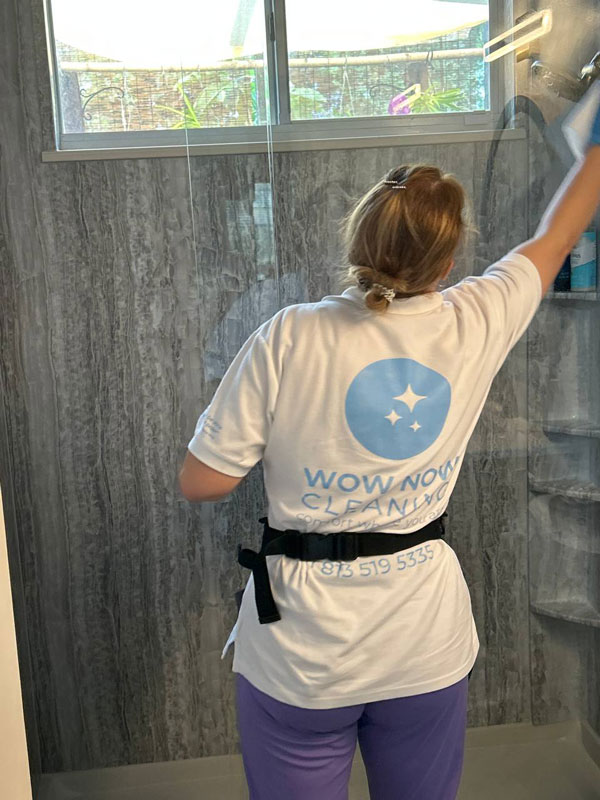
Shower doors made of glass provide an easy way for hard water stains to be seen. Even if the rest of the bathroom is clean, cloudy glass can make the place seem unfinished.
The problem is that glass is easily scratched, and some shower enclosures have protective coatings that prevent water from accumulating and forming stains. With the wrong cleaning method, the coating can be destroyed or damaged and leave lasting marks.
Step 1: Identify the Type of Buildup
Before using any cleaning solution, examine the glass carefully. White spots that appear after the water has dried may simply indicate new mineral deposits.
When the glass becomes opaque over a larger area, this will be a sign of both soap scum and minerals. Hard patches on the lower side of the shower door also suggest that the water has been standing and evaporating in the same spot for some time.
This distinction is important since a regular cleaner will clean the fingerprints and everyday messes, but will not remove the mineral deposits.
Step 2: Choose a Suitable Cleaning Solution
For ordinary, uncoated glass, a diluted white vinegar solution may help loosen light mineral buildup.
If the shower door has a special protective coating, check the manufacturer’s instructions before using vinegar or any acidic cleaner. Some coatings can be affected by products that are otherwise considered safe for glass.
A commercially formulated hard water remover may be more appropriate for heavier deposits, provided it is approved for the specific glass surface.
Avoid combining different cleaning products. In particular, never mix vinegar with bleach or products containing chlorine. These combinations can release dangerous gases.
Step 3: Let the Product Work
One usual error that people do is use a cleaning solution and wipe it immediately.
Mineral deposits need some time to soften. So, follow the directions of the product and spend the necessary time for the product to take effect.
The specialized vinegar solution may be used for only a few minutes for light deposits. However, don’t keep the acidic solution for too long on the surface.
Do not let the solution dry out on the glass surface.
Step 4: Wipe Without Scratching
Use a soft microfiber cloth or a non-abrasive sponge to wipe.
Do not use steel wool, rough scouring pads, abrasive powders or scrapers. These may scratch the surface of the glass, which is usually very visible in the light.
If the product does not come off, it is better to use the cleaner once again rather than press harder.
Step 5: Rinse and Dry Thoroughly
After cleaning the surface, rinse the glass with clean water.
It is essential to wash the glass after cleaning, as the leftover cleaning liquid may leave residue on the glass surface.
Finish cleaning by drying the glass with a clean microfiber towel or a squeegee. Pay special attention to the bottom edge and corners where water usually accumulates.
What About Old, Stubborn Shower Door Stains?
In case you have used various safe cleaning methods but the glass continues to appear foggy, chances are that there is a more serious issue. Certain stains originate from permanent etching of the glass and not from minerals that can be removed. Therefore, using regular cleaning products will not restore the original look.
This is why it is important to tackle hard water stains as soon as possible. Removing newly formed mineral films is much easier than tackling years of buildup and glass damage.
Faucets and Fixtures: Avoiding Finish Damage
Faucets are another place that hard water stains can be really observed. Mineral white rings at the base, spots on the faucet handles, and chalky build-up at the water outlet can make new taps seem old.
Unlike regular glass, faucets have many different finishes. Cleaning different finishes like chrome, brushed nickel, stainless steel, polished brass, matte black, and oil-rubbed bronze often requires different cleaning methods.
When using a product that works well on one finish on another finish, you may not realize that you will damage the finish.
Step 1: Remove Dust and Loose Debris
Begin with a dust mop made of microfiber or a hard floor-compatible vacuum.
If you are using a vacuum, ensure that its brush roll is appropriate for wooden floors or is removable. Carpet-cleaning brush rolls can scratch certain finishes. Don’t forget to properly clean the corners, baseboards and other places where dust builds up under the accessible furniture.
How to Clean Chrome Faucets
Chrome is highly regarded due to its lustrous finish that appears fresh and stylish. On the downside, water stains are especially prominent on polished chrome surfaces.
For light deposits, use warm water and a little mild dish soap. A soft microfiber cloth should be used to eliminate everyday deposits.
If mineral deposits persist, consult the product instructions before using a diluted acid solution to clean the chrome. Some chrome-plated fittings may withstand cautious cleaning, but continuous exposure to acids can damage the finish.
When you finish cleaning, make sure that you rinse the faucet and dry it.
Cleaning Brushed Nickel and Matte Black Fixtures
Brushed nickel and matte black fixtures need to be given additional care.
The way they will look is determined by their finishing, as being overly aggressive when cleaning them can lead to shiny areas, discoloration, or scratches.
When cleaning these fixtures, the best course of action may be to begin with the following:
- Warm water.
- Dish soap that is mild.
- A microfiber cloth that is soft.
- Rinse them with clean water.
- Drying them completely afterward.
Matte black finishes can also get damaged easily since scratches or changes to textures are readily visible. Even if a cleaning product removes the lime deposit, it can still result in the fixture looking worse than before.
How to Remove Buildup Around Faucet Bases
The spot where the faucet connects to the sink is often ignored. Water usually gathers around the base of the faucet, especially when it is consistently being used.
In order to take care of this area:
- Use a wet microfiber cloth to remove dirt.
- Utilize a suitable cleaning product on the area
- In case the area has very small spaces, use a detailing brush to clean it.
- Make sure to wipe off all the things used without pushing anything into the faucet
- Rinse and dry everything around.
Remember to check the borders around the handle and the faucet base, as those spots are likely to have even more grime than the outer surface.
What Not to Use on Bathroom Fixtures
It is necessary to avoid common cleaning hacks that can lead to costly damages. Avoid cleaning tools such as steel wool, scouring pads, powdered detergent and strong chemicals unless advised by the manufacturer of the sink. Moreover, do not leave cleaning products on the sink for longer than recommended and do not mix different cleaning products.
It would be highly unfortunate to replace a faucet because of its surface being damaged due to the wrong cleaning method.
We believe that the key is to concentrate on the material first and on cleaning product second. If designed properly, the cleaning process should make a fixture look better while preserving the surface of the fixture.
Prevention: How Often to Clean Hard Water Areas
Eliminating hard water stains is essential; however, not allowing them to develop again is crucial for achieving the most impact over time. Bathrooms in Tampa houses can have mineral-laden water flowing through them daily. Even if all stains are removed at one time, new stains will keep coming back if the same surfaces are subjected to wetness. Just a few small modifications to your typical bathing practices can eliminate this problem.
After Every Shower
The mineral deposits can be easily minimized by taking a short and simple action sequence after having a shower.
- The first thing to do is to take a squeegee and go over the glass shower door.
- Wipe down the excess water drops off the chrome parts and the other similar fixtures.
- Once done, leave the shower door ajar to allow good air circulation.
- Furthermore, remove any excess water pooling around flat surfaces.
- Finally, ensure everything gets dry.
This process takes less than 10 minutes but is sure to save a great deal of time later on cleaning.
Weekly Bathroom Maintenance
Make sure to do extra maintenance at least once per week in areas where mineral deposits usually form.
Places that should be cleaned include the following:
- Shower door and glass panels.
- Taps and their casing.
- Shower heads and outlets.
- Edges and outlets under sink.
- Bathtubs.
- Corners of shower/washbasin where water collects.
When cleaning the surfaces mentioned above, use cleaning products that are the most suitable for that material instead of using the same product for all types of surfaces.
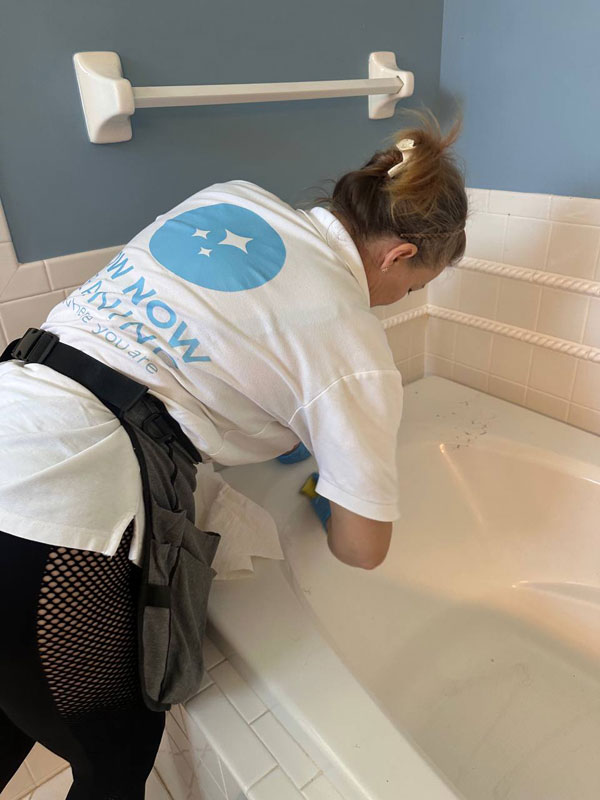
Cleaning your bath weekly will also help you prevent soap scum from mixing with mineral deposits and forming a thicker layer.
Regular house cleaning Tampa homeowners can rely on helps keep bathrooms fresh and prevents mineral residue, soap scum, and dirt from accumulating on frequently used surfaces.
Monthly Deep Cleaning
Doing a thorough cleaning of the bathroom at least once every month allows to clean some areas which are normally neglected when cleaning more often.
This includes cleaning around places where moisture collects like faucets, doors, edges, corners, etc.
If someone uses the bathroom very often, it may become necessary to sanitize these spots more regularly.
Should You Consider a Water Softener?
If hard water stains reappear quickly after cleaning, the problem might lie in your water supply.
Water softeners reduce the amount of calcium and magnesium in the water.
This reduces the mineral buildup in your plumbing system, including bathroom fixtures, shower doors, and other surfaces that come in contact with water.
However, installing a water softener is a separate improvement project. The right softener depends on your water, your household use, your plumbing system, and your budget.
Testing the water hardness may help homeowners who constantly deal with mineral buildup.
When Hard Water Stains Are Permanent
Not every white mark on glass can be eliminated. It can happen that homeowners will waste hours trying to apply different products unaware of the fact that the initial surface is already damaged.
Gaining knowledge about the distinction between mineral deposits and permanent damage will help you avoid wasting time, money, and nerves.
Mineral Deposits vs. Glass Etching
The mineral deposits are found on the glass surface. They usually can be dissolved or loosened with the correct cleaning solution.
Glass etching is a different thing. It refers to a situation when surface itself gets damaged and gets little modifications that modify the light that goes through the product.
It may happen as a result of long-lasting influence of mineral deposits, wrong chemicals, and/or abrasive cleaning techniques.
To get to know whether there are some problems it is advisable to clean a small part of the surface with an acceptable product for glass. If the cloudy appearance remains after getting rid of the residue, maybe it is a case of a permanent surface damage.
But this is not a 100% reliable test for all types of glass.
Signs That a Stain May Be Permanent
Take notice of the following signs of trouble:
- The glass surface stays cloudy despite the removal of dirt properly.
- Even after drying, the glass surface does not look clear.
- The damaged surface is uneven or rough.
- The marks are not due to residue on the glass surface; they have become part of it.
- The previous cleaning has not helped even after several attempts.
As you see, employing harsher chemicals or tools will most likely not help you at this point. Actually, aggressive cleaning may increase the damage incurred.
Some etched glass can be restored to its original state through professional help depending on how badly it was damaged. In some cases, glass replacement would be the only feasible solution.
Tampa Bay Water and Why Stains Build Up Faster
Residents of Tampa and surrounding communities are familiar with the problem of hard water deposits in bathrooms. One of the reasons is the water quality.
As per the City of Tampa, hardness in Tampa’s municipal water could be about 140 – 300 parts per million (ppm) or between 8 – 17 grains per gallon. The numbers could change during the year, meaning lower values during the wet months than in the dry period.
Although these minerals do not create concerns in terms of water usage, they create deposits when water evaporates from faucets and other surfaces.
Why Tampa Bathrooms Need Regular Attention
Casa de baths is an exposed area where water gets used in many different ways. Every shower, hand wash or tap used creates a different opportunity for minerals to appear.
Secondly, generalized warm humid conditions mean bad moisture management in bathrooms. Although high humidity does not cause the formation of mineral deposits in any way, it creates a situation where wet surfaces remain wet for longer or where inadequate ventilation occurs.
Shower doors and chromed fittings help to notice even minor mineral deposits. Water stains on the surface of clear glass create an undesirable image in the whole bathroom.
Hardness of water is not exactly the same everywhere throughout the area. Different parts of Tampa may receive water from completely different sources and treatment facilities. If you are unsure about your water quality or do not know the hardness rate of water, you may use the local water quality report.
Professional Bathroom Deep Cleaning
Cleaning a bathroom and deep cleaning are two different things.
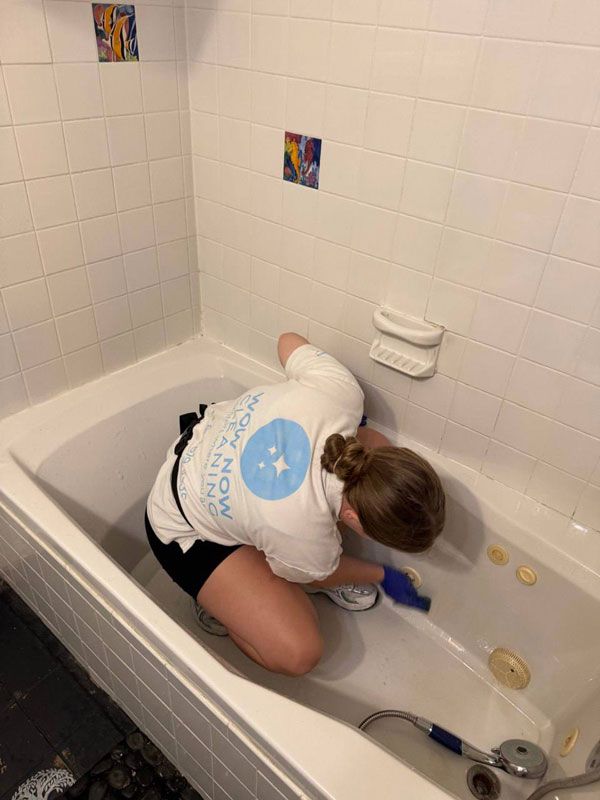
Routine cleaning usually entails cleaning only the surfaces that are visible, i.e., areas like sinks, toilets, countertops, and floors. Nevertheless, minerals and soap will build up in some previously neglected places, such as shower tracks, around faucet joints, edges of glass, and in corners.
When all of the above are not cleaned sufficiently, simple cleaning is insufficient. Professional services are necessary.
What Professional Bathroom Cleaning Can Address
Depending on how your bathroom looks and what materials you have used, detailed cleaning can include:
- Washing shower doors and glass parts.
- Removing mineral deposits from the surface.
- Cleaning fixtures and taps by means of correct products.
- Removing soap residue from suitable surfaces.
- Washing sinks, bathtubs, and their vicinity.
- Cleaning corners and shower tracks.
- Cleaning tiles and the surface of the grout.
- Removing dust, dirt, and other residues from bathrooms.
The cleaning task is always determined by the surface and nature of the buildup. Some etched glass and damaged finishes can require special restoration services due to their condition.
Why Choose a Professional House Cleaning Company in Tampa?
For many homeowners, finding sufficient time for regular cleaning of the bathroom is quite challenging. While they are busy at work, taking care of family duties, and performing ordinary housekeeping jobs, certain areas of the bathroom, such as shower doors and faucet bases often get forgotten and neglected.
Fortunately, working with a reputable cleaning services provider will help homeowners get rid of some of their responsibilities.
At Wow Now Cleaning, we recognize that having a clean bathroom is much more than just removing dirt and grime. Cleaning glass, fittings, and other neglected parts of the bathroom can improve the entire appearance of your home.
Our company offers residential cleaning services taking into account various cleaning surfaces, household requirements, and cleaning priorities. If you are interested in ordering regular cleaning services or choosing a more elaborate one, be sure that we can help you.
Explore Our Deep Cleaning Options
Standard for annual maintenance cleaning is often not sufficient, especially if the bathroom hasn’t been cleaned thoroughly for several months.
Our deep cleaning options are designed to reach those areas that require more time, attention, and effort, including bathroom surfaces where mineral deposits, soap residue, and dirt have accumulated over time. This cleaning option is often what you need to perform before having some guests over, during a busy seasonal transition period, to prepare the premises for new occupants, or just to take better care of your home.
The service can include more thorough attention to bathroom, kitchen, and frequently touched places in the home, depending on your needs.
If you are unsure whether you need regular cleaning or deep cleaning, our team can talk to you about the condition of your home and what services are right for you.
We strive to give our clients the cleaning option that fits their needs and gives them the results they want.
Keep Your Bathroom Looking Clean with the Right Care
In bathrooms, hard water staining may frequently occur, however, many mineral deposits may also be removed with appropriate products and constant care. Light formation on suitable surfaces may be helped with white vinegar, but more solid deposits would need specific cleansing solutions.
To avoid formation, you should dry your shower doors, wipe the taps, and regularly clean the places where mineral deposits form.
In case your bathroom requires more attention than your usual effort can provide, Wow Now Cleaning will gladly do the job for you!
Contact our team to get more details about our residential cleaning services in Tampa Bay and get your free estimate.
FAQ
OTHER ARTICLES

Hey everyone, I’m Khrystyna! I’ve got experience in all sorts of cleaning, which I gained at Wow Now Cleaning. Now I’m sharing it with you all! I’d appreciate any comments or feedback on my tips, so feel free to write!